


Yes it is true. Claude Code is pretty cool.
I started using it properly about a month ago, initially just testing out its competency at one-shot app creation, for which I was careful to manage expectations of course.
Watching this coding agent work through your request, while keeping you in the loop to check that its work is aligned with your preferences, is quite fascinating. There is something quite magical and intriguing about how this little bot can just take your initial prompt and crank out a full-fledged application. It is equally cool to see how it can carry out various tasks that would otherwise require a decent level of coding proficiency.


I have found a lot of inspiration from a number of Substack newsletters on the joys of using Claude Code, including from Privacat, Nathan Lambert and Jasmine Sun.
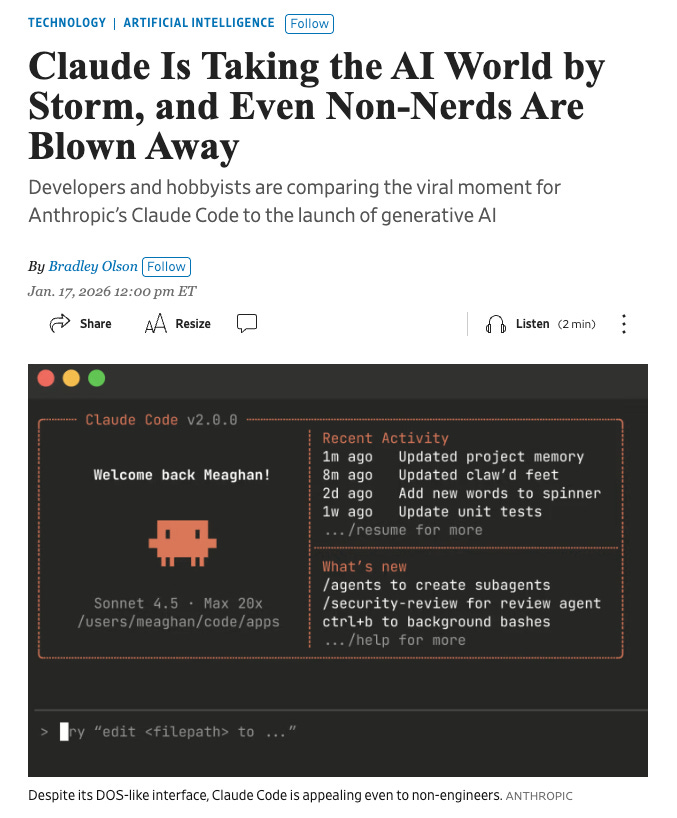
The interesting thing about Claude Code is that, despite it being a coding agent and therefore seemingly only of interest to coders or those more technically capable, it is capturing the attention of those outside the AI bubble. Even the Wall Street Journal is writing about Claude Code, so it must be something cool even among the normies.
As fun as all this has been (and maybe even a little addicting), my experience with Claude Code did alert me to something which I think could very easily be overlooked for those who have been ‘Claude-pilled.’
Products like Claude Code make it easier and cheaper than ever to build software solutions. And if these codings agents continue to improve, so it is quite striking to think of the possibilities down the line.
The temptation that this fuels is to just build a bunch of new stuff. If all you need is a bit of natural language prompting and a machine will just turn your idea into reality with a little further input from you, then think of all the ideas that do not need to be just ideas anymore. Imagine all the things you could build. Maybe you really are just one weekend away from a building the next killer app that makes you a fortune in a week.
The obvious problem here is that as people get carried away with the magic of Claude Code, they start to forget the fundamental questions about what they are doing. They forget about the aspects of building that AI cannot necessarily do for them.
AI can do many things, but it cannot do everything.
In the midst of your Claude psychosis, you may forgo why you are even building the thing in the first place as well as the principles for building it well.
And this is crucial, because if you end up building the wrong thing in the wrong way, and then deploy it for other people to use, you may disappoint your users at best or even harm them at worse.
To avoid this, you need to think about what it will take to actually build things properly with products like Claude Code:
Taste. Are you solving a real problem that actually needs solving?
Distribution. How do you get people to care about your solution to the problem?
Trust. Does your solution actually work well?
Trust is particularly important. In a sea of new apps being built and deployed everyday by eager vibe-coders leveraging the power of agents, why should people use your app? What makes it so much better than the rest?
Even if your app solves a problem that others are struggling with, and even if you have an audience willing to use it, if it does not deliver on the promises, then you just get a high churn rate. And all your late nights with Claude Code will go to waste.
Alternatively, if you take the time to build a solid solution that works well, then you have a much better chance of gaining trust. And this thens feed into the other factors; the more people believe in your product, the more they share it with others which leads to more users and therefore more feedback on how well your app is doing.
The key to gaining this trust is embracing governance.
Governance is not just about legal compliance. Fundamentally, governance is about implementing measures that help you build more reliable products.
You should think of governance as an enabler. If you get it right from the start, then not only do deal with any compliance issues, but you also give people another reasons to trust your product. And you feed the growth flywheel.
To get governance right when building with Claude Code, I think you need to start by managing three things: quality, data and risk.
Get these three things right and you will be well on your way to establishing a unique selling point for your product and a moat that most will not think to work on until it is too late.
In this post, I walk through the steps and prompts for quality, data and risk management when using Claude Code. If you are building apps with Claude Code that you plan to release into the wild, then this is essential reading.
If you find this content valuable, make sure to share it with others.