

No, AI is not about to delete all jobs. This is what happens instead.
AI presents challenges and opportunities

AI will kill all lawyers.
This was the title of an article in the Spectator that I recently read. And it prompted some thoughts. Many thoughts.
The article gives the views of an anonymous English barrister on AI and legal practice. And the picture he gives is pretty gloomy: AI will ‘completely destroy’ the law as we know it.
Why such a stark warning? It is based on this particular barrister’s recent experience using AI for legal work, as he explains:
‘Last week we did an experiment, a kind of simulation. We took a real, recent and important case – a complex civil court appeal which I wrote, and it took me a day and a half. We redacted all identifying details, for anonymity and confidentiality, and we fed the same case to Grok Heavy AI. And then we asked it to do what I did. After some prompting, the end result was…’ He shakes his head. ‘Spectacular. Actually staggering. It did it in 30 seconds, and it was much better than mine. And remember, I am very good at this.’
[...]
‘It was at the level of a truly great KC. The best possible legal document. And all done in seconds for pennies. How can any of us compete? We can’t.’
Lawyers belong to one of the most conservative, risk-averse and arguably outdated professions that exist. They are used to holding high positions in society because their services are so necessary; as long as we have societies organised by a large, complex body of rules, we need people who can understand them and provide guidance on how to follow those rules.
Or do we?
Because if you read this barrister’s view on AI and its potential impact on the legal profession, you may think that if AI can do just as good as a qualified legal expert, then what is the point of having these experts?
You could go further: what is the point of knowledge work done by humans if we can get AI to do it?
These general-purpose machines, trained on massive amounts of data with huge amounts of computing power, seem capable of pretty much any cognitive task a human could do. Just feed it the right prompt and you have your desired output, produced in seconds or minutes at the most and on the cheap.
But as I was reading this Spectator article, I could not help but notice a rather glaring omission which reveals why ‘AI displacement’ is more complicated than what some people present.
AI is not about to take everyone’s job.
Those who believe in a mass exodus where AI renders human roles completely redundant are not thinking carefully enough about what AI is and the impact it can actually have.
AI can do many things. And it can do many things really well.
But it cannot do everything. This is the simple truth.
This means that AI should really be seen as a force multiplier, not a replacement.
And this is the case even for the legal profession.
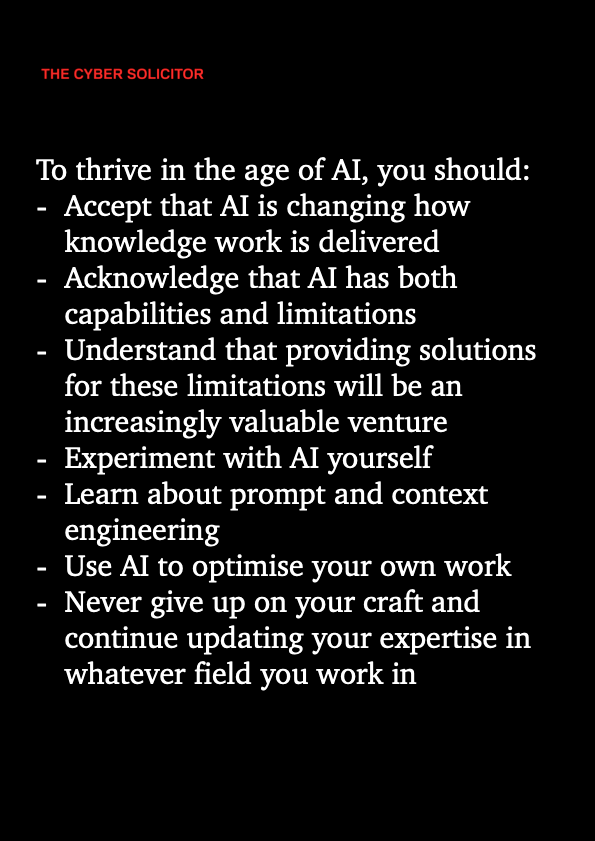
To thrive in the age of AI is to understand AI’s limitations as well as its capabilities and the gaps it therefore creates in our society.
Those gaps are where humans still have an important role to play, whether this is in the legal industry or any other domain where AI is being deployed.
In this newsletter, I cover three core ideas about how to navigate the trials and tribulations of AI in our modern world:
What AI can do
What AI cannot do
What you should do